


I know, I know, I KNOW. The headline sounds like I uploaded a selfie and a robot reconstructed my face like I was a Real Housewife and Claude was my plastic surgeon on speed dial.
Well, that’s not exactly what happened. I still have the same face, the same body, the same two children who sometimes interrupt my 6 a.m. workout. And I still have the same number of minutes in a day, which is…not enough. (And while it IS the same number of minutes that Beyonce has in a day, I don’t quite have the same resources).
But AI has absolutely made me hotter. Not in a Kris Jenner/Lindsay Lohan way (unfortunately? Is it weird that at 40 I’m fascinated by face lifts? A topic for another day…). This transformation is less shocking but more useful. Basically, AI has helped me stop guessing and endlessly researching so I can focus on doing. It took the approximately 752 small decisions involved in eating well, working out, getting dressed, taking care of my skin and figuring out which supplement is actually doing anything, and created straightforward plans I can follow.
For a busy mom, this is the real glow-up. What I don’t need is more information (mental load, anyone?). What I do need is someone (or something) to absorb all the information, remember my preferences and constraints, filter through it all, and tell me what matters and what to do about it.
Here are the 10 ways I’ve actually used AI to look and feel better, and the prompts you can steal to do the same.
1. I used it as a nutritionist who remembers what I ate
I logged my real meals into Claude for a week (uploading photos is the quickest and easiest; you can also use voice-to-text) and asked it to estimate calories, protein and fiber. This wasn’t because I want to spend my life tracking every almond (did that enough in the early 2000s, wahh), but because it turned out my ideas of “high protein” and “high fiber” were a bit…overly optimistic.
For example, I thought my breakfast of eggs, black beans, hummus, half a sourdough English muffin and cheese was GOALS. But it landed around 380–410 calories with only 21–23 grams of protein. AI rebuilt it to hit my goal: at least 30 grams of protein, under 380 calories, with enough fiber to keep me full (adding egg whites, spinach and nutritional yeast helped). It also gave me multiple breakfasts that would hit the same goal, including a Kodiak oats bowl with almond milk, collagen, chia and hemp.
The benefit wasn’t in the math itself (although that helped), but learning the pattern well enough that I don’t NEED to do the math every morning.
**THE PROMPT** You are my registered dietitian. Here is everything I ate today, with approximate portions [upload photos]. Estimate calories, protein and fiber; tell me where I am likely under-fueled or overdoing it; and suggest small realistic changes to reach [your goal]. I am [age/height/activity], and I do not want an extreme or restrictive plan.
2. I made it build a workout schedule around my real life
There is infinite workout advice online and none of it is personalized to me and what I’m already doing. Which is: I do Solidcore three times a week (which is my whole personality, ask me about it), run two easy miles with a parent group, own dumbbells, use the Peloton bike and app, and want to build muscle without making exercise take over my life.
I gave AI all of that and asked whether I was doing too much or not enough, whether I needed more weights, and whether I needed to add sprints or stairs because that’s what a podcast told me to do.
It built a Monday–Friday split: Solidcore plus the easy run Monday, heavy upper body Tuesday, Solidcore Wednesday, heavy lower body Thursday, Peloton Friday, then rest or walking on weekends. It also created two repeatable 25–30-minute dumbbell workouts using only my floor, a mat and a couch. The plan worked because it accounted for what I already liked instead of handing me an imaginary person’s schedule that I wouldn’t do.
**THE PROMPT** You are my personal fitness trainer. Build a weekly split using the workouts I already do: [list them]. My goal is [goal]. I have [equipment], want to work out [number] days per week for [minutes] per session and have these fixed schedule constraints: [list]. Tell me what to add, what to stop, and where I need recovery.
3. I asked it to define my style in three words
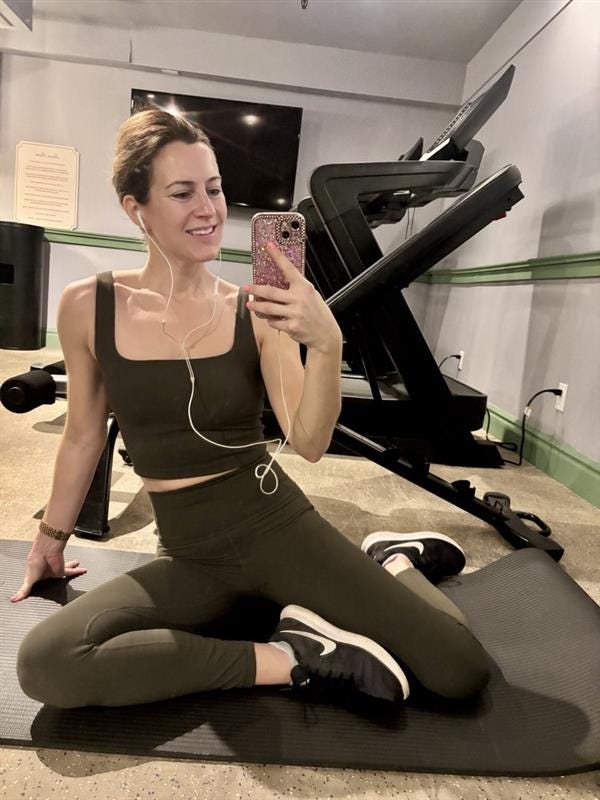
Anyone else follow Allison Bornstein? I love her fashion advice and wanted to try out her Three Word Method to describe my style, but couldn’t figure out what mine were. So I took a picture of a few weeks’ worth of outfit mirror selfies and uploaded them to Claude.
My three words came back: Chic. Effortless. Modern. It was simple, but weirdly clarifying. Now when I’m deciding whether to buy something, I can ask: Is this chic, effortless and modern…or is it a fantasy version of me who summers on yachts (dream) and never has grubby hands grabbing my pants?
And the more you give AI here, the better advice it gives. So upload photos of outfits you love, outfits you hate, the things you wear constantly and the clothes that you never wear. Pinterest inspiration photos, etc. It can identify the common thread, translate it into outfit formulas and point out where your closet and your actual life don’t match up, and tell you what you need to add to your wardrobe and what to toss.
**THE PROMPT** You are my personal stylist. Based on these outfit photos and what I wear most, identify three words that should define my personal style. Explain why, name the silhouettes and details that support each word, and give me five repeatable outfit formulas for my week.
4. I got a personal color analysis
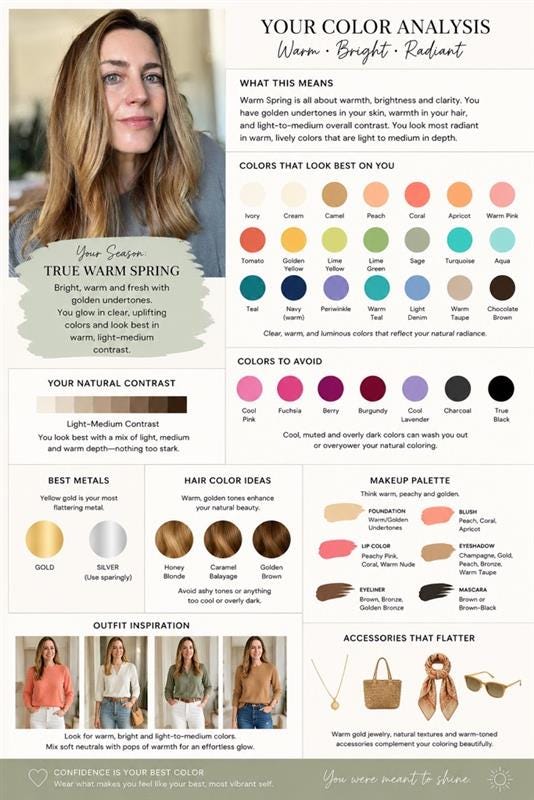
After looking at multiple well-lit photos, AI placed me in the Warm Spring family: warm-neutral golden undertones, green-blue eyes, golden-brown hair, low-to-medium contrast. Suddenly it made sense why cream, camel, warm navy, olive, coral, peach, cognac and gold tend to work, while stark white and bright colors wash me out (even though I still wear them sometimes because I like them and who cares).
It didn’t ban black (aka half my wardrobe) but did suggest warming it up with gold jewelry, camel colors or a warm lip. Color analysis is also great for choosing flattering makeup colors (cue me trashing the cool-toned shimmery pink lip glosses I’ve been buying since the days of Jane makeup at Walgreens…anyone?).
**THE PROMPT** You are my personal stylist. Analyze my coloring from these unfiltered photos taken in natural light. Identify my likely season, explain your confidence level, give me the best neutrals, whites, accent colors, metals and makeup shades—and tell me how to keep wearing black if it is not ideal. Give me all the information in a beautiful, visual, easy-to-understand infographic.
5. I used photos to find the clothing shapes that flatter me
Color is only one part of getting dressed. I’ve also used AI to assess which silhouettes, pant and sleeve lengths, necklines, proportions and shapes make an outfit feel balanced and look flattering on me. The key is to show it several angles and include measurements, comfort requirements (like, “I hate turtlenecks” or “I feel frumpy in wide pants”) and the shoes you really wear. A shape can be flattering and still be useless if it requires heels and a strapless bra on a Saturday that you’re spending bent over the sandbox.
The biggest benefit is before the shopping begins. Instead of browsing 865 dresses, I can ask AI to turn my shape and style words into a tight shopping “brief.” This means fewer tabs, fewer returns, less hemming and hawing about each purchase. And sadly, fewer clothes for my alternate yacht life (for now).
**THE PROMPT** You are my personal stylist. Using these photos [full-body] and my measurements [upload measurements], identify the most flattering silhouettes for tops, pants, jeans, skirts, dresses, and full outfits. Focus on proportion and fit, not changing or criticizing my body. Then create a shopping checklist using my three style words: [words].
6. I made it troubleshoot my hair
When I was dealing with hair thinning due to postpartum hormones and stress, I asked Claude to compare topical versus low-dose oral minoxidil and to identify what else was worth checking. It pointed me toward the boring but important things to watch—ferritin and iron, thyroid, vitamin D, hormones, stress and adequate protein—rather than convincing me that one magical gummy would solve all my problems.
I also used a photo when my color was turning brassy and reddish near the roots. AI explained that blue or blue-violet products made more sense for me than purple (which is what I always heard about), then built me a use cadence: toning shampoo every 7–14 days, hydration between uses, and a mask or bond treatment every few weeks. Tiny problem, highly specific answer, solved immediately.
**THE PROMPT** Help me troubleshoot [shedding/breakage/brassiness/scalp issues] using these photos, my timeline, medications, recent lab results, diet and current products. Separate likely causes from guesses, rank next steps by evidence, and tell me what requires a dermatologist or medical workup.
7. I had it audit my face…and my entire skincare shelf
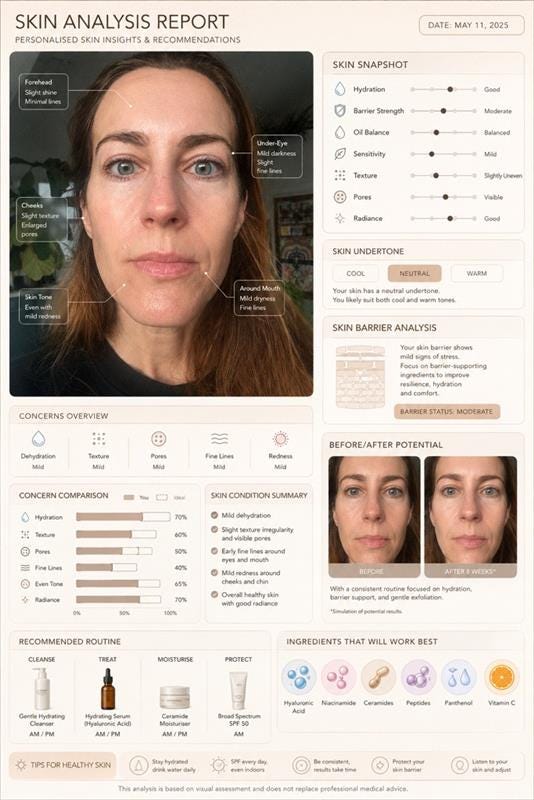
I uploaded clear makeup-free photos of my face and asked for a dermatologist-style assessment of what was actually visible and what I should focus on. The “diagnosis” was a healthy baseline, with mild chin congestion and texture, some redness and post-inflammatory marks, some visible pores, and possible dehydration around my mouth and chin. The recommended treatment was retinoid, limited BHA or lactic acid, barrier-supporting hydration, niacinamide, daily SPF—and no aggressive scrubbing or over-exfoliating.
This was particularly helpful because I already use tretinoin, vitamin C, red light, occasional acids, several hydration products, and more (skincare junkie, hi). AI could see the risk was not that I was doing too little, but that I’m capable of doing too much.
**THE PROMPT** You are a conservative board-certified dermatologist reviewing my routine. Based on these makeup-free photos and this complete current product list, identify visible concerns, likely irritation risks, redundant ingredients and the simplest AM/PM routine. Do not diagnose disease; flag anything that needs an in-person dermatologist. Give me all the information in a clear, easy-to-understand infographic.
8. I researched skin treatments
Before a girls’ trip to Korea last year, I asked AI to compare skin treatments…because when you start going down the TikTok rabbit hole of Korean treatments, it’s a long way to fall. I had it assess the treatments through the lens of my skin: fair, melasma-prone (thanks, pregnancies!), some rosacea tendency, already using tretinoin, and unwilling to look like Samantha Jones post-chemical peel while on vacation. It sorted out the lower-downtime options such as skin boosters and ultrasound treatments from more aggressive ones. It specifically warned that heat-based treatments and overly aggressive laser settings can flare melasma.
Once I got to the clinic, I still met with the on-site doctor for a consultation first. AI didn’t replace a dermatologist or practitioner, but helped prepare me to walk in knowing generally what to focus on and what to ask. (I ended up getting Thermage, Rejuran aka salmon sperm injections, and a German brand of Botox…full post coming soon).
**THE PROMPT** Compare these cosmetic treatments for my goals: [list]. My skin history is [melasma/rosacea/acne/etc.], my current actives are [list], and my maximum downtime is [days]. Rank options by evidence, risk, downtime and likely benefit, then give me questions to ask a board-certified dermatologist.
9. I made it fire half my supplements
At one point my supplement situation included some combination of AG1, vitamin D, psyllium, colostrum, pumpkin seed oil, collagen, magnesium glycinate, Nutrafol, fish oil and iron. It was honestly too much to take, too much to keep track of, and too much to spend money on.
I uploaded my lab results from my most recent blood test and asked Claude for maximum benefit with minimum supplements, prioritizing hair, skin, digestion, sleep and overall health and immunity. It helped separate higher-value basics from nice-to-have extras that don’t have clinically proven results. It also connected low ferritin to the hair shedding issue.
The streamlined supplement stack prioritized a multivitamin, iron when appropriate, fish oil, magnesium and psyllium; collagen became optional. It also caught timing conflicts and told me exactly when to take everything (because for best results, iron shouldn’t be taken with coffee, calcium, magnesium or fiber).
**THE PROMPT** Audit my complete supplement stack for my goals, diet, medications and recent labs. Identify duplicates, weak-evidence products, interactions and timing conflicts. Give me a minimum-effective stack, an optional tier and a list to discuss with my doctor. Do not recommend treating a deficiency without labs or clinician guidance.
10. I asked for the honest, whole-person ‘hotter’ plan
Eventually I just asked it…what would make me hotter? I said I wanted the difference to be noticeable across my body, face, clothes and energy.
The answer wasn’t game-changing tbh but it was a good reminder. Claude said that for me, hotness meant even, healthy-looking skin; slightly more structured brows (which made me switch to a slightly deeper shade of brow pencil/wax); soft eye definition without heavy liner; hydrated, defined lips; clothes with a clear point of view; stronger more statement jewelry (still need to get on this one), a strong body with good posture; and energy that reads before any individual feature does. Define either eyes or lips, not everything at once. Stop treating every category as a separate renovation project.
That may be the biggest thing AI has done for me: help me zoom out. When I’m obsessing over one supplement or one high-protein breakfast, it can remind me that being hot isn’t about one thing. Everything is connected…your sleep affects your skin, your protein affects your hair, your workouts affect your posture, and obviously, feeling confident affects everything.
**THE PROMPT** Give me an honest but NOT mean glow-up audit across skin, hair, makeup, body/fitness, clothes and energy. Use the photos and context I provide. Prioritize the five changes with the highest visible impact for the least time, money and maintenance. Do not recommend weight loss unless I explicitly ask.
Disclaimer!! A few rules before you hand the computer your face
AI is only as good as the context you give it.
Use multiple clear, unfiltered photos in natural light.
List your full routine, schedule, budget, health history and non-negotiables.
Ask it to rank the most high-impact recommendations instead of dumping 30 ideas on you.
Report back what worked and what didn’t so the plan improves.
And please do not let a chatbot diagnose a mole, prescribe medication, treat an eating disorder or talk you into an injectable. AI is not a doctor…I repeat, AI is NOT a doctor!. Use it to organize information and prepare for qualified professionals, NOT impersonate them.
Also: privacy matters. Don’t upload anything you would be horrified to see escaped into the wild. I stick to ordinary photos and information I’m comfortable sharing. #trustnoone
In short, AI didn’t make me hotter by giving me more to do (because I’m typically overwhelmed as it is). It helped me do fewer things more consistently and removed the decision fatigue that makes self-care feel like yet another full-time job.
And at the end of the day…being less stressed about how to be hot, is hot.
Have you used AI for skin, hair, makeup, body, clothes, wellness? Drop your tips and prompts! And, if you found this helpful, please share it!
Very fun, I tried a couple of the prompts. I used AI to build a capsule wardrobe skill. I went to the tailor and got my measurements. Then I took photos of items in my closet and told Claude that I was looking (because I'm very print-heavy) to create a capsule wardrobe of classic items. It came up with a list of gap items that I was missing. Now, when I'm thinking about buying something, I upload it against the skill for it to confirm whether or not it matches one of the items.
this is AMAZING! as a very busy, postpartum mama in the midst of a "wanna glow up but also don't have more than 10 consecutive minutes to myself these days" era, I am trying all of these